FREE PAPER CRAFT TEMPLATES
Paper blind box template
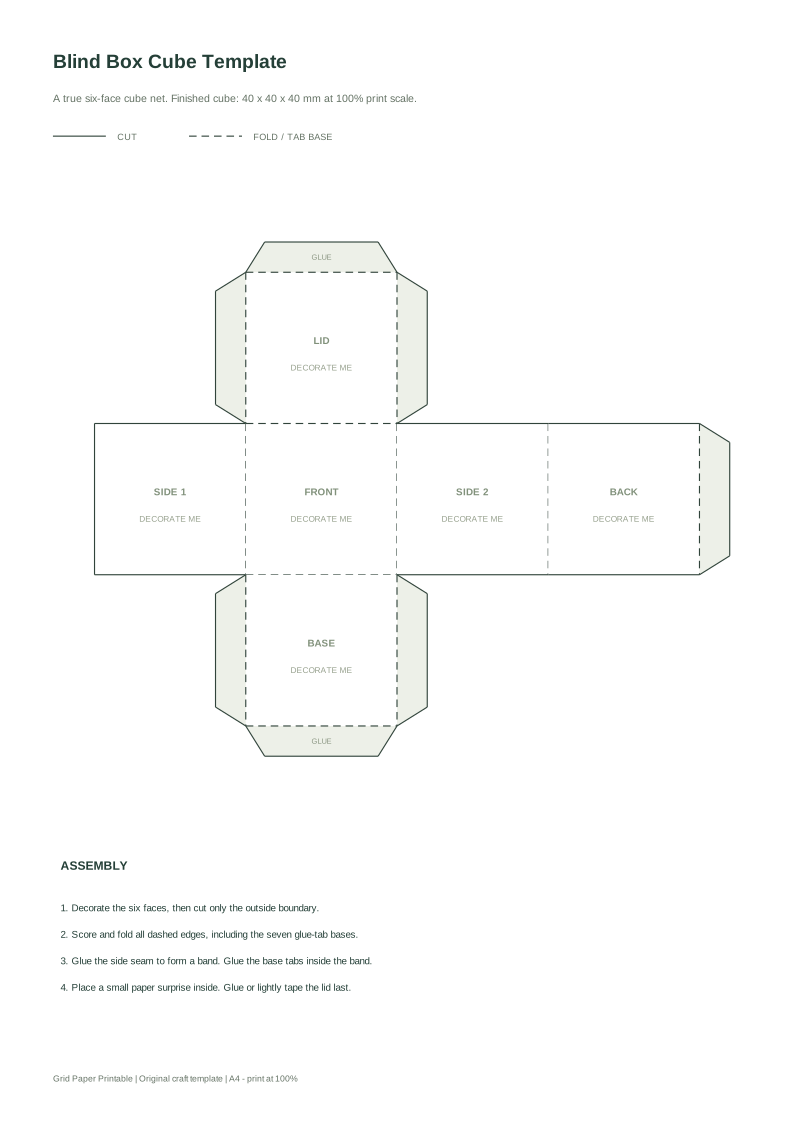
Turn one printed cube net into a small surprise box. The template has six equal square faces, dashed fold lines and seven glue tabs. Decorate it before folding, then close the lid around a lightweight paper surprise.
Original designsPrintable PDFsStep-by-step instructions
Choose your template PRINT & MAKE
Choose a template.
Print at 100% / Actual size.
Each PDF includes its intended paper size.
STEP BY STEP
How to make it.
Decorate and cut the net
Print at 100% to make a cube with 40 mm sides. Decorate all six labeled faces. Cut around the outside boundary, keeping every shaded glue tab attached.
Score the dashed lines
Use a ruler and a blunt scoring tool to crease the shared face edges and tab bases. Fold each face inward along its dashed line. Do not cut the dashed lines.
Build the side band and base
Join the right-hand side tab to the inside of the first side face to form a four-face band. Fold the base into position and glue its three tabs inside the surrounding sides. Let the joins set.
Add the surprise and close
Place a small, lightweight paper item inside. Fold in the lid tabs and glue them, or use a little removable tape if you want the box to open again.
A few useful tips
- At 100% the finished cube measures 40 x 40 x 40 mm. Printer scaling changes that measurement.
- A blind box is a rigid folded box. If you want a flat pouch, choose the separate blind-bag template.
- Glue one join at a time and let it set before adding weight.
GOOD QUESTIONS
Frequently asked questions.
Quick answers before you print.
What size is the finished blind box?+
At 100% print scale, each square face measures 40 mm and the finished cube is 40 mm wide, high and deep.
How many faces and tabs are on the net?+
The cube has six faces and seven tabs: three for the lid, three for the base and one for the side seam.
Can I print it on ordinary paper?+
Yes, although light cardstock makes a sturdier box. Match the paper weight to what your printer can feed reliably.
More things to make.
All paper crafts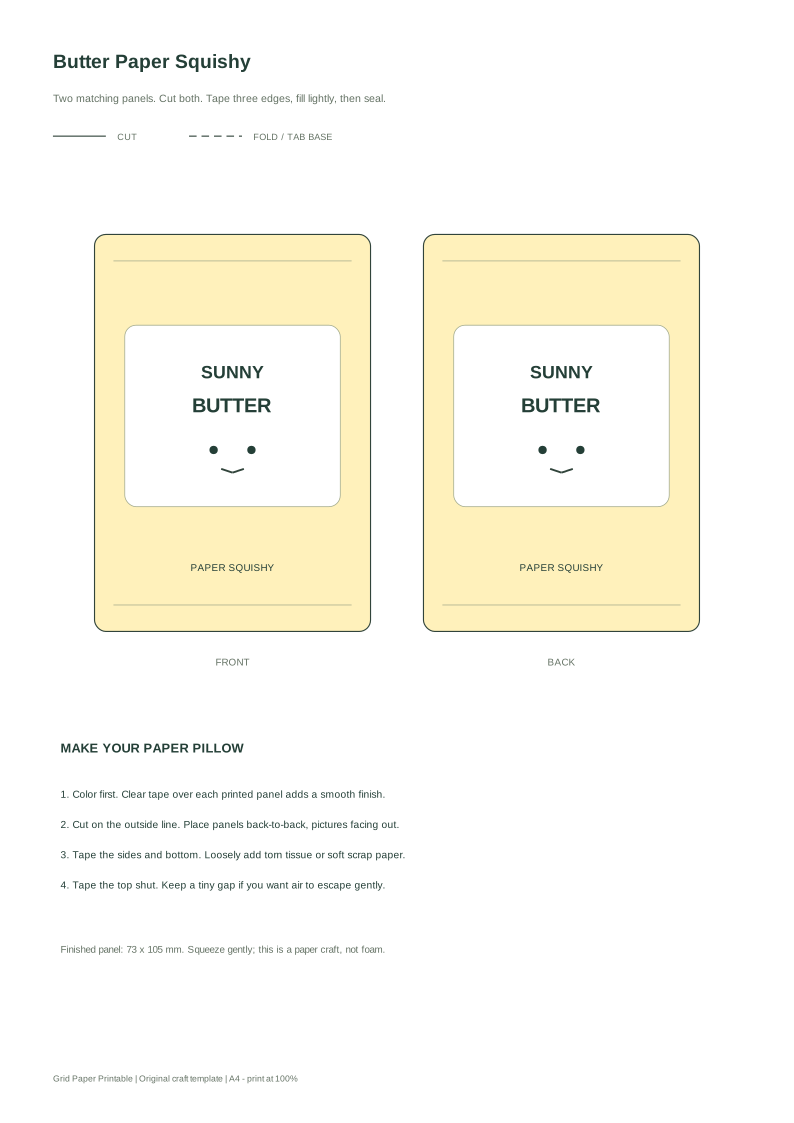
FREE PRINTABLE PDF
Paper squishy templates
Download original paper squishy templates for a butter packet, snack pouch or pretend phone. Print the free A4 PDFs and follow the assembly steps.
Get the templates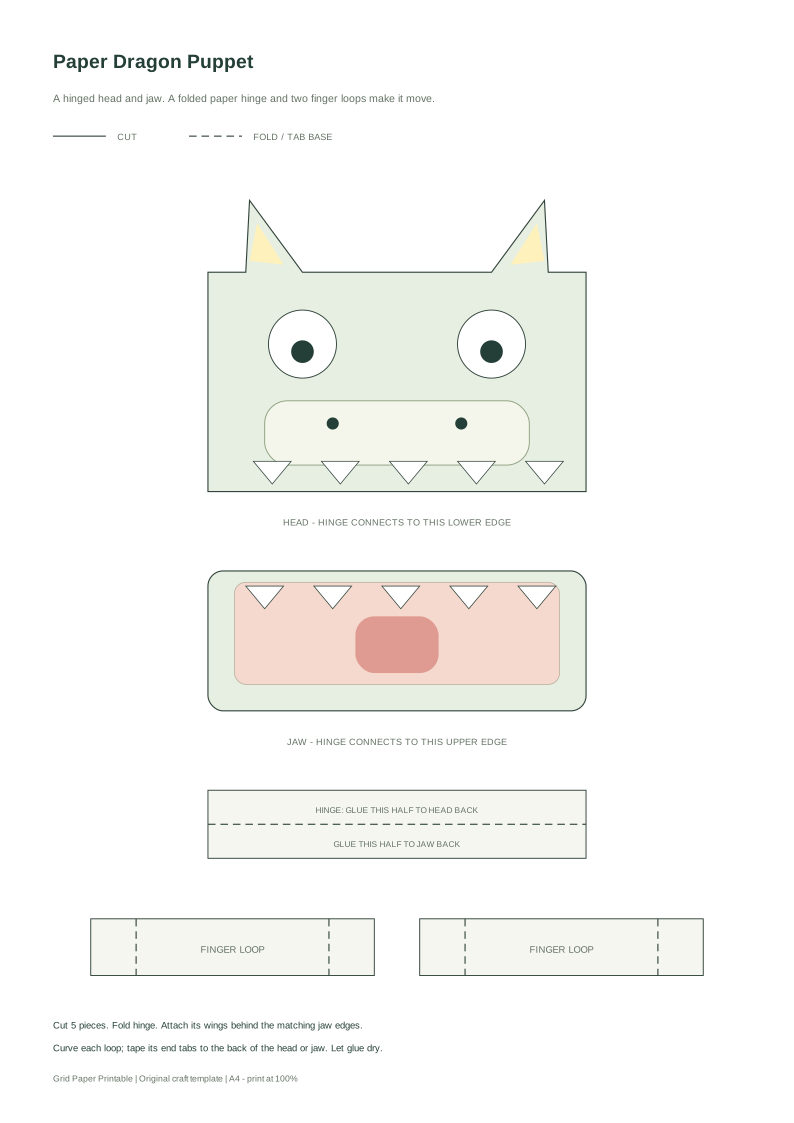
FREE PRINTABLE PDF
Paper dragon puppet template
Print an original paper dragon puppet with a moving jaw. Download the free A4 head, jaw, hinge and finger-loop template with assembly instructions.
Get the templates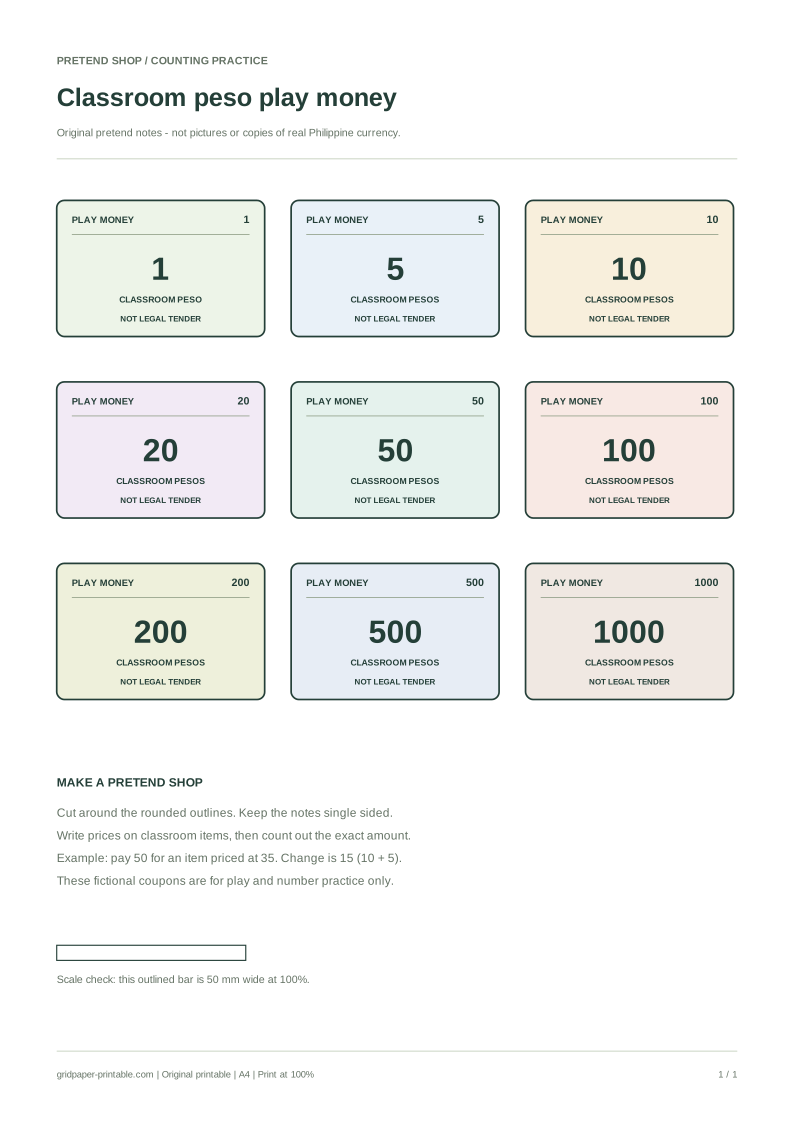
FREE PRINTABLE PDF
Philippine peso play money
Print original classroom peso play money for a pretend shop and counting practice. Free color and ink-saving A4 PDFs with nine clearly fictional values.
Get the templates